Moto411, Moto 411

Sunday, July 01, 2007

Part Review: Motovation "No-Cut" Frame Sliders

Quality: ++++-(4 out of 5)
Functionality: +++--(3 out of 5)
Appearance: ++++-(4 out of 5)
Value: ++---(2 out of 5)
Overall: +++--(3 out of 5)
Pros:
  • excellent fit & finish
  • easy installation
  • no bodywork modification required
Cons:
  • expensive
  • prices on replacement parts are insulting
  • no-cut bracket causes fairing damage on impact
  • sales staff hard to reach to answer questions

Introduction

Anyone who's crashed, downed, dropped, or otherwise abused a motorcycle in the past at some point considers purchasing frame sliders. It is useful to remind even the most "seasoned" of us that frame sliders are called frame sliders (and not "engine cover sliders", "fairing sliders" or "muffler sliders") for a reason: they are not meant to protect anything in earnest except for the frame. That being said, one tends to incur much less damage to one's engine covers and fairings in a low-side with frame sliders than without them. However, if you're considering the possibility of a crash while wanting to preserve the newness of your stock fairings, then I suggest removing them and keeping them in the garage, no matter how many frame sliders you own.1

Impression

My initial impression when I ordered these suckers was, "they'd better be darn good," since I paid about US$220 for my set (frame sliders, clutch slider and swing-arm spools/sliders). I will say that they met those expectations, but didn't exceed them. Don't get me wrong, they are quite nice. They are made of high-quality materials with a good attention to detail. The designers even went so far as to taper the left-side frame slider so that it wouldn't require it's own bracket, but could still be mounted without cutting the fairings. To my knowledge, Motovation is one of the few companies to do this (TSR is another).

Installation

Installation was fairly obvious. The only thing to note is that the torque specs on the 2005 YZF-R6 engine bolts is fairly low. The right-side no-cut bracket mounts to the frame via a single bolt and there is not much keeping the bracket from articulating on that mount point.

To be fair almost everyone's designs are similar in this regard. I have seen one (and only one) maker of frame sliders who actually makes no-cut mounting brackets with two mounting points for the bracket, and a third for the slider. I wish I could recall who that is, but I can't as of this writing.

Mmm, sliders:

Use

Normally, I don't like to down my bike just to test a product, but this seemed an appropriate occasion, so we went to dump at Streets Of Willow to see if these sliders would perform as well as they look. I picked the right side, since there was more to damage (exhaust and all) and it would give an opportunity to test out the clutch slider as well.2

Ooo, that's gotta hurt:

Clutch slider (turned upwards):

After executing a textbook low-side, I had plenty of data to evaluate the sliders. As you can see, the sliders did their job and held up quite nicely. As predicted, the right frame slider did rotate on the engine mount point and was crushed right into the fairing. The fairing lost. Luckily, I had my fiberglass track fairings on at the time (which seemed prudent given where I was at the time), so a repair wouldn't be that difficult.

Back on the track at Thunder Hill after "testing" the sliders (and replacing the exhaust can); note the crack in the fairing below the frame slider:

When I purchased the sliders, Motovation had not yet made replacement parts available for purchase. They constantly ignored my e-mails and phone calls to replace my rashed parts. Perhaps this was because they knew they were eventually going to make extra spools and things easy to purchase via their website.

Well, they finally did, and I have to say I was astonished at the cost of a replacement spool. I was already somewhat put off by the cost of the slider kits to begin with, but this was ridiculous. They wanted US$45 for a right-side replacement spool and another US$65 for a replacement clutch slider!

Conclusion

I liked how the Motovation sliders held up in a crash, but I never expected them not to. They looked great, but their cost was high and got even higher post-crash. I especially didn't like the fact that I would be spending more in replacement parts than what most other makers charge for entire sets. And, although not many of us like to crash or think about it too much, I ultimately decided to sell what was left of the Motovation sliders and try a different (less expensive) brand which wouldn't leave me high and dry after my next...uh..."incident".

1. bigpuss is up to two sets on his F4i.

2. What lugnut means to say is that he is an idiot and was lucky enough to have any frame sliders when he decided to throw the bike into a right-hander while trying to trail brake like he was Noriyuki Haga.

Thursday, May 31, 2007

The Racing Experience Part 4: Our Second Race

And we're still improving by leaps and bounds! That's the nice thing about starting from the bottom; you have no place to go but up and improvement comes quickly. I will enjoy it while I can, I have a feeling things will get harder from here on out.

Second Race Goals and Expectations

For our second race I set only two formal goals: 1) finish at least fifth from last and 2) look much cooler than I did last time. Lugnut had mentioned during the first race that if someone of my skill level focused a little bit on looking good, it might actually help me go faster. Lugnut did have a historic basis for suggesting this: at a tack day last summer I was "caught" by a track photographer mugging for his camera. I saw he was at the corner and I did my best to lean that bike over more and get on the gas. Vain? Yes. When I was mugging was I going faster? Yes. The photographer came in after the session and mentioned just how transparent my efforts were, but he also remarked that I did indeed take the corner better because of it. So, as a beginner, just pretend there's a photographer in every corner and your bound to shave some seconds off your lap times.

Early in practice I was hard at work trying to look better for the photographer.

I did indeed need to shave seconds off my lap time. If I made the assumption that roughly the same people would be entering the race again this time and that they wouldn't be getting any faster (I know, that is faulty, but bear with me), I needed to shave at least three seconds off best lap time from the previous race. But, if you also assume that everyone else is trying to shave 3 seconds off their lap times, it would make sense that I would need to do better than that.

I Need All The Practice I Can Get

Four sessions, which amounts to roughly 16-20 laps, is all you get on Saturday before the Clubsman races. It's also a pseudo qualifying as your practice times are factored into your starting position. I need much more practice, but my most basic goal for practice was to start off doing times close to where I left off during the last race. The morning was cool and foggy and, being in practice group 1 with the rest of the Clubsman, we went first—with no time to let the fog lift or the track to dry. I was only moderately worried about the slightly damp track and decided to use the session to try some new lines I picked up while watching the AMA races one week before. No such luck. My visor fogged up within seconds of hitting the track and opening the visor only made it worse. We were riding in a cloud and I had not put any sort of treatment on my visor. I pulled into pit lane, coated my visor with saliva (an old SCUBA diving trick) and went back out. Again, it fogged up almost instantly. I didn't get in a single real lap that session, lost out on a full 25% of my practice and pulled into the paddock really pissed off. I wasn't mad at anyone or anything, but I really needed the laps and my first session was a complete loss.

Lugnut had a solution (he always does). His spray bottle with a highly diluted Dawn dish-soap solution did the trick. Spray it on, wipe away the excess and bam, no fog! It seems this Dawn solution does just about anything you need it to (cut grease, stop fog, quench thirst, etc.), but at the moment I was just happy that I would never fall victim to the foggy visor again. It was all a moot point for the rest of the sessions as the sun did eventually break through the fog, but at least we're ready for next time.

The sun came out and all was well.

By the end of the second practice, my lap times were down in the range of the last race, so I felt I was doing okay. I kept working on my lines and my braking for the next two sessions and ended up taking another second or two off my race times from our last race and was gridded on row 5 (versus row 10 like last time).

On a side note, I had the benefit of learning what it feels like to run out of gas on the track. Lugnut is the master of giving me just enough gas for the laps I need to run plus some contingency fuel to account for the warm-up lap, delays, etc. However, if you don't remind him to put gas in the tank, you tend to run out pretty quickly on the following session. I was leaned over in turn 2 when the bike first shut down—it is startling and does disrupt the chassis a touch, but it's really no big deal. Once the bike was straight up and down again, it fired back up. Through the carousel (a long downhill 180° left-hand corner), the bike really tried to die, but keeping it upright seemed to help nurse it along. I nursed it around the track and back into the pits—stuttering evermore as I neared our pop-up. It died just as I put it up on the stand. At least then we knew how many more laps the "contingency fuel" gave us.

The Start

I don't have the oldest bike our there, but I'm definitely in close contention for that title. I'm down about 20 horsepower compared to newer 600s, am heavier (both the bike and rider), I have stock gearing, and, at the time of this race, only had one start under my belt. Yet, there I sat with half the field behind me waiting for the green flag. As the green flag dropped and the field headed up the sweeping left-hander into turn 2, I ended up roughly 10 spots from last. Below is a video of the start which I am ashamed to post, but it must be shown because the shame it invokes will only make me go faster next time. That, and we're going to change the gear ratios a bit. Infineon is a technical track with few straight-aways and, with the F4i's stock gearing, no use for 6th gear. We are going to switch to a 520 chain, drop a tooth up front and add a tooth in the rear. For a track where acceleration off the line and out of corners can make a huge difference, this should help quite a bit.

The Race

I was feeling really good once we all got slotted into place. I had been passing some people during practice, but the race pace is always a bit faster and I had to wait and see if my pace was going to be up to par. I set my sights on a bike in front of me, reeled it in, and passed it. Wow! That feeling is very addictive. I wanted to do it again! So I set my sights on the next bike and started reeling it in, albeit more slowly. As I was reeling in my next target, I was also passed. "Oh well," I thought to myself, "maybe I can use this guy to help tow me up to the next bike." It did help for a lap or two, but then I lost touch with him and was back on my own.

This bike did pass me, but helped tow me along for a lap or two.

I was determined to make that one more pass before the end of the race. The bike or the rider's leathers were red so it was easy to keep targeted and I was making up time, just not fast enough. Also, unbeknownst to me at the time, there were a string of two or three bikes that had been behind me for most of the race. They hadn't been fast enough to get by me, but they were close enough that any mistake would give them the chance they needed.

I certainly wasn't holding them up, but they were ready to pass if the chance arose.

After seven laps, we were given the white flag at the start/finish. I had one more lap to catch "red bike." Unfortunately, I was dealt a new problem as a white bike came flying past me to beat me into turn 1. What? Oh no he didn't! I needed to take that spot back and I was pretty sure that I could get it back coming out of 2 and going into 3a if I just got on the gas early enough. I leaned the bike through the corner, tried to point it to the inside of the white bike and got on the gas hard. This is when the race got extra fun.

But first, a bit of historical perspective. At my third track day I was on a set of Dunlop street 208s that had seen a moderate amount of riding (and obviously a previous weekend of track time). The tires felt fine for most of the day and then, very suddenly from one lap to the next, became greasy. I opened the throttle out of a right hander and the rear slid out, I shut the throttle off, it caught and spit me out of the seat. There was no crash mind you, just some pain between my legs. I thought it might be an anomaly so I collected myself and got ready for the next corner. It happened a second time, although less intensely, so I decided those tires were done and I should call it a day. Now, I really hadn't been paying attention to how much time/how many heat cycles my current track 208s had endured. Now that I think back, it was about three track days and one practice/race day. Before last race though, we hadn't been using tire warmers on those tires. Needless to say, the tires could have been in better shape. Now, back to the race!

As I got on the gas hard (well, as hard as a stock F4i can) in turn 2, I felt a familiar sliding feeling. Not the "oh, the tire will eventually catch" feeling, but the other one, the "oh, my tire feels much different that it did last lap" feeling. So I shut off the throttle. And the tire caught. And the bike shook. And my foot came off my right peg. And the bike cavitated side to side a bit before heading straight again. I was not going to pass the white bike back, but at least my bobble hadn't caused me to loose a spot and I was on the last lap. I was sure however that the lost time probably allowed whoever was behind me to close any gap there might have been. Plus, now there was blood in the water, they had seen and could smell my weakness. The tire slid a bit through the remainder of the right-handers and I kept my fingers crossed through the long high-speed left-hand carousel that the left side of my tire was doing a bit better. It held and, as I was coming to the last corner before the checkered flag—a tight low-speed right-hander—I was passed coming into the corner. Knowing my tire had seen better days, I turned my bike in, tried to get it mostly upright again and pinned the throttle towards the finish line. It was no use, the SV650 had more grunt and I lost yet another spot mere yards before the end of the race. Had I fulfilled my goals? I wouldn't know until the results were posted days later.

Had he done it? Tune in next time...

Yes, yes I had. Exactly fifth from last and more than 4 seconds faster than last time. And I think the pictures are looking a little better too. For next time, we have fresh rubber and new gearing so look out! If I can keep the bike up, I'm gunning for mid-pack! Ride safely and see you at the track!

We would like to take a minute and thank our "sponsors": Moto411.com, Big Pussy Racing and Bog Bros Serf Shop. Anytime you support one of these brands, you support us and our quest to build this site into an evermore useful source of unbiased information and reporting.

"Sponsors":

Monday, April 30, 2007

The Racing Experience Part 3: Our First Race

Nerves of Steal! (Rusty, Old, Broken Steal)

It was a week before Team Moto411.com's first race and I was nervous to say the least. Not that I really should have been, it wasn't even a real race. What I was about to participate in was a Clubsman Race—a race with no points, no prizes and no prestige. The Clubsman Races serve two main purposes: 1) they allow you to get used to riding competitively and 2) they allow the AFM to assess your skill level before they let you on the track in a more serious series.

I was most nervous because I have never ridden Infineon Raceway on anything but a pit-scooter. Tourist Trophy for the PlayStation 2 has a pretty accurate recreation, but a controller and a monitor can help only so much.

What's even cooler than Helimot leathers? A Helimot transponder case of course.

The Pre-Race-Weekend Track Day

To ease my first time racing/first time at the track worries, I signed up for a track day at Infineon the Friday before the Saturday AFM sessions. Not every AFM weekend is preceded by a track day, but in this case it was. Our good friends at Pacific Track Time (with whom I took my licensing course) set me up with a few sessions so I could get a feel for the track.

I find that, as an amateur, I am always far too tense the first time I get on the track and hence I exert huge amounts of effort to go rather slowly. As all my muscles fight against each other and the the bike, my riding is choppy, my performance is poor and I'm exhausted after a couple laps. This particular weekend it took me 6 sessions and the race to start feeling comfortable and fluid. The Infineon Raceway track is, in my opinion, quite fun and quite nice. Despite, or maybe due to the elevation changes and the lack of straightaways, I found the track very pleasant once I loosened up. However, if I didn't go the day before, race day would have been painful.

If you have natural skill and/or youth to spare, I could see this being a much smaller problem. But, if you merely dabble in motorcycle racing and your youngest days are starting to tick away, I suggest getting at least 15 laps in on the track before your three practice sessions on race day.

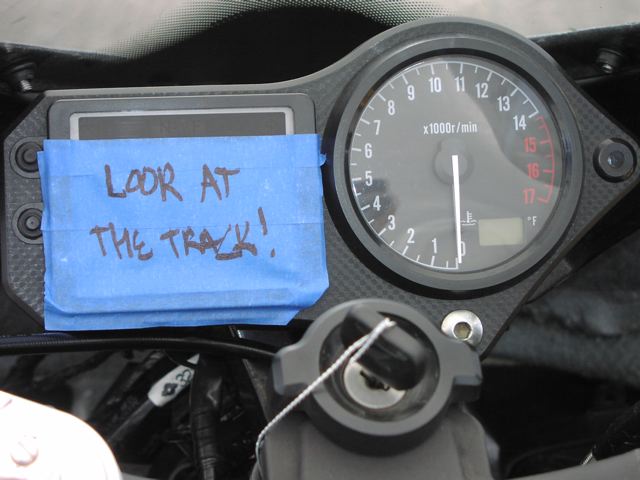
By the way, lugnut made me a couple seconds faster with a pen and some tape. I highly recommend it!

What is this, amateur hour? Yes, yes it is.

The Value of A Hotel/Motel—No Really!

Even though this track is only an hour or two away from the "Moto411.com racing garage," we decided a hotel close to the venue would be easiest on everyone especially considering we had a track day prior to the race. I had a fair amount of Hilton hotel points saved up from a job that required me to live in a Los Angeles Doubletree for a month (ugh!), so we used those to book a room at the Embassy Suites about 10 minutes from the track. Short of using points, usually lugnut and I find the cheapest motel we can—with some pretty funny/scary/disgusting results. The Embassy Suites, in all its mediocre glory, made us feel like kings in a castle compared to our usual accommodations. The real value of not getting up at 4am to go to the track is that, come race morning, you feel nice and rested.

Many riders camp at the track in tents or trailers and take advantage of Infineon Raceway's decent shower and bathroom accommodations. Given the sheer number of people at the track overnight, we staked our paddock claim for the next day and left the bike and tent—making the following morning even more leisurely. We did lock up the bike, but, to this day, a motorcycle paddock is one of the few sacred places left in our world—where everyone looks out for each other and bad apples are still rare... for now. That all might change as this sport becomes more mainstream. I hope it doesn't.

The real value of the hotel was the continental breakfast. It was a complete made-to-order breakfast bar! Omelets, pancakes, waffles, eggs, bacon, sausage, you name it and (if it was mainstream) they had it! The Moto411.com team ate well that morning. I'm not talking high quality, but if I had to choose between the hotel breakfast and a Denny's, I would choose the hotel breakfast—I know... that's not saying much.

Remember, the most important thing about your bike—wheel stripes!

Race Day Morning

The Saturday of the Clubsman Races consists of rotating practice sessions for all the racers and then the three Clubsman Races (light-, mid-, and heavy-weight) at the end of the day. All the real races are the following day, on Sunday. The morning was relaxed and went something like this:

Riders Meeting

Practice Session Group 1
Practice Session Group 2
Practice Session Group 3
Practice Session Group 4
Practice Session Group 5
Practice Session Group 6

Practice Session Group 1
Practice Session Group 2
Practice Session Group 3
Practice Session Group 4
Practice Session Group 5
Practice Session Group 6

Break for lunch

The afternoon was equally as predictable:

Practice Session Group 1
Practice Session Group 2
Practice Session Group 3
Practice Session Group 4
Practice Session Group 5
Practice Session Group 6

Practice Session Group 1
Practice Session Group 2
Practice Session Group 3
Practice Session Group 4
Practice Session Group 5
Practice Session Group 6

Mid-Weight Clubsman Race
Light-Weight Clubsman Race
Heavy-Weight Clubsman Race

Photoshop a Ducati 749 underneath me and win a free Big Pussy t-shirt!

You are placed in your practice session group by speed/times at the last event and, on the busiest race weekends, all Clubsman must be in group 1. If you start going faster, you can move up a group—but not as a Clubsman at a busy event.

Overall I had four practice sessions of about 5-6 laps each and then one 8 lap race. I felt I was getting smoother and more comfortable throughout the day and, even though I didn't get faster on the last practice session, I was much more loose and relaxed and did not fatigue as easily.

I spent most of my practice sessions following a Ducati 749 around the track. We were both equally slow and, during the later practice sessions I felt that, under braking, I could pass her—a young lady standing roughly 5' 3" with eye lashes too long to be real. In an earlier session, a rider dove deep inside both of us, passing me and hitting her. It bumped her wide, but she put her head back down and got right back on her line. I asked her about it later and she said something to the effect of "that's good practice for the race! It threw me off for a second, but it was no big deal." At that moment I had rethink my approach, find my male genitalia and get my ass somewhat more in gear.

Lugnut, with all his "championship winning [whining?] experience" had been telling me to get my ass in gear all along, and he was right. He had made two [other] key observations: 1) When I came in from practice, he could comfortably put his bare hands on my brake rotors and 2) he remarked that, I looked like I was on a Sunday ride. A picture I saw later (and which I will not be posting here) confirmed that, indeed, when everyone else was tucked down in their most aggressive racer form, I looked like I was pulling up to a stop sign. Also, yeah, I could use my brakes more often. Damn, that lugnut is good!

I'm easy to spot because my whole row was nice enough to move in front of me when the green flag dropped.

The Race

I was gridded 45 out of 54 (outside of row 10) for the race. There were three rows behind me and quite a few bikes in front of me so I decided to be a bigpuss for the first race and not go for any holeshot for the sake of me and everyone around me. My start wasn't what I wanted, even for a bigpuss, but we all eventually filed in line and the racing began.

Sponsorship money-shot! Now, if only I had any real sponsors.

My only goal was to finish, and not finish last. The entire "crew" agreed that I could not count DNFs as being behind me nor could I count riders who remounted after an incident and returned to the track. I had to pass at least one other rider. Also, it would be nice if I didn't get lapped. The short of it is that I did achieve my goal, but fate dealt a helpful hand.

After everyone had settled into the race, I found myself behind a familiar Ducati 749. I was pretty sure there was at least one other rider behind me, and that was confirmed when he passed me shortly thereafter. The rider that passed me, the Ducati 749 and I made up the tail end of the pack. And there we stayed, lapping for 3 or 4 laps—not making any time on each other, just following the track around and pausing ever so briefly at the frequent offs and yellow flags.

The rider that passed me towards the beginning of the race began to fade around lap 5 and the Ducati 749 was opening up a slight gap on us—it was time for me to make my pass and ensure that I didn't actually finish last. I came up beside him into eleven and got a better drive down the front straightaway, passing him right before start/finish—right at a waving yellow flag. Crap! I waved him back by and started setting him up again.

Half way through the next lap, the red flag came out and the race was over. An incident had left a bike laying on the track and, with 6 of 8 done, that was it. Although, I was only lapped by one rider, I finished last. Or had I? In all actuality, I completed my pass before the waving yellow and before the start/finish line. With only half the following lap complete, I could only hope my transponder crossed the line before his. It had! I was second to last! Success!

Am I not hot? When I was in my Indonesia, I was a gigolo!

Conclusion

That was totally worth it! It was the most fun I've had in ages. My goal for next time? I'm getting that Ducati 749 and hopefully one or two other riders. Lugnut figures if I actually use my brakes instead of coasting into corners like I was pulling up to a drive-through, it shouldn't be too hard—even for a monkey.

We would like to take a minute and thank our "sponsors": Moto411.com, Big Pussy Racing and Bog Bros Serf Shop. Anytime you support one of these brands, you support us and our quest to build this site into an evermore useful source of unbiased information and reporting.

"Sponsors":

Thursday, March 15, 2007

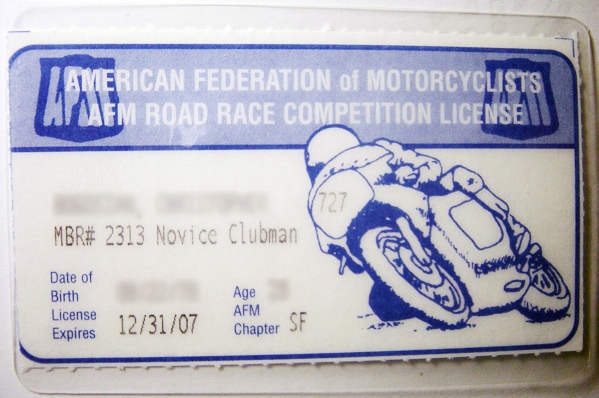
The Racing Experience Part 2: Getting Licensed

I Need Another License?

Yes you do! At first, the race licensing process seems like a rather inconvenient barrier to entry. It costs money, it eats up a day of your valuable time and, once you're done, you might find yourself thinking: "I don't think I actually learned anything today that I couldn't have just read in the rules, and my track day money could have been more usefully spent on one-on-one instruction." In fact, the licensing process might be enough of a hassle that you'll skip racing again this year. And that's exactly (well, errr, partially) what it is: a barrier to entry for casual wannabes.

Imagine if every yahoo that got a bug up his boot to go racing showed up at the next race, papers and check in hand, and was allowed on the track to try and qualify. Safety issues certainly come to mind and don't get me started about what else would end up horribly wrong with the sport. The licensing process is incredibly important to a) ensure everyone is starting with the same, although very basic knowledge of racing protocol (you may find this shocking, but there are people who never read through the rules if they don't have to), b) demonstrate that you can ride a motorcycle well enough to keep up with Noriyuki Haga on one of his warm-down laps, c) observe if you can conduct yourself appropriately both on and off the track and, d) make sure you're not going racing as result of some drunken party bet gone horribly awry. In other words, this process forces you to think twice or even three times about what you're getting into.

Putting The Process In Motion

Getting licensed is actually pretty easy once you look into it. It's even easier if you've raced with other recognized organizations in other regions or countries. If it has been less than five years since you've raced with a recognized organization, you don't have to attend any new racer courses. However, for new racers, I've outlined "five simple steps" below for getting into AFM racing.

First: download your application here. Now read it! The entire thing!

Second: if you are new to road racing, read this.

Third: in case you didn't see this when reading the link from the second step, sign up for New Racer School (NRS) at an AFM-approved provider. I went with Pacific Track Time because I'm already familiar and comfortable with the folks who run it. I suggest that, if you have been to track days at one of the NRS providers below, you choose the one with which you are most at ease—this will make you much less anxious the day of. Feel free to contact them before your NRS and ask them what to expect and see if they have any pointers.

Pacific Track Time 530.223.0622
Keigwins @ The Track 650.969.5609
Zoom Zoom Track Days 888.929.9666

Fourth: go back to the second step and read through all the links and documentation the AFM provides before your NRS!

Fifth: prep your bike for racing. Download these two documents (2007 AFM Rulebook, AFM Tech Inspection Sheet) and get your bike as close as you can to race-ready. The NRS only requires that your bike be track day ready (if you haven't been to at least one track day, I might suggest you not go racing quite yet), but prepping your bike to race spec is an important learning experience that provides a better perspective of the effort it takes to go racing.

Optional Step: read all the rules. I know it's 84 pages, but for our sake, at least skim it.

The Day Of

My NRS school was held at Thunderhill Raceway Park in Willows, California—a not-so-distant 175 miles from home base. However, in order to get there in time for bike tech and the rider meeting, we had to rise at a painful 4am. Luckily I had lugnut to drive the Moto411.com/Big Pussy/Bog Bros/Amsoil rig as I nursed a Red Bull and tried to sleep (hmmm, that just doesn't sound right). In hindsight, the thought of staying in a cheap motel the night before began to look really good to us. Next time we wont be so cheap.

Fortunately, we were already familiar with Thunderhill from a previous outing. So, despite our tiredness, we felt relatively comfortable when we arrived. Unfortunately, we didn't spend that much time on the track during the previous track day and were by no means up to full speed. Regardless, knowing the track was a huge help.

We rolled in at about 7:15am and got one of the last spots under the giant metal canopy. There were already many "camps" set up outside of the permanent structure and, if any one of them had decided to use said structure, we would have been SOL considering we left our pop-up at home (i.e., always bring your pop-up just in case). At that point, it seemed that luck was with us that day.

Considering the bike was 98% race-ready, we breezed through sign-in and tech and had time to get everything unloaded and ready before the riders meeting. Well, I guess lugnut unloaded everything and let me bask in my "rider's glory" however ridiculous that prospect seemed to me.

A note of clarification here, most track day companies offering NRS certification combine their NRS with a normal track day (otherwise it would be prohibitively expensive) and you must abide by all of the track day rules in addition to the NRS rules as laid out by the AFM representatives present at the track. Hence, you must go through all of the track day processes before you get down to NRS business.

Moto411 Race Bike: ready for licensing!

After we arrived, signed in, got teched, and attended the rider meeting, our NRS classroom session began at 9am. Many of the attendees were clearly ansty. While the rest of the track day goers went out to hit the circuit, we were stuck in the classroom. Remembering why we were here allowed us to keep our focus despite the distraction. The classroom session takes about 2 hours and covers only the most basic rules and protocols. At the end of the classroom session, you must pass a test of roughly 25-30 questions. If you don't pass this test, they should take away your license to breed much less race. Regardless, I'm glad they have some sort of test before they let people loose in the pits and on the track.

After the classroom session, they give you an orange belt to wear the remainder of the day, split you up into groups of three or four, assign you to an evaluator and get you out on the track.

The Orange Belt

Before I go any further, let's talk about the orange belt. First, I'm not the fittest of all people and wearing a bright orange belt around the part of my body with the largest circumference proved most unflattering. Second, that orange belt is on you because your behavior is being assessed for the remainder of the day—all your behavior. Even after your track evaluator signs off on your track skills, you are given the rest of the day to fail—both on and off the track. Break the pit speed limit—fail. Fall over on your bike anywhere—fail. Get in an argument with someone in the pits—fail. I didn't anticipate doing anything "common sense stupid," but things can happen and wearing that orange belt reminded me off that fact every time I took a breath.

On-Track Evaluation

The actual on-track evaluation was pretty simple. During one of the track day's "fast group" sessions, the evaluator leads the group around the track once before the first licensee takes the lead for a lap. Then, the next in line takes the lead for the subsequent lap, etc. The point is not to go as fast as you can (in fact, you're told specifically not to do so), the point is to keep the group together so the evaluator can assess a rider's technical skill and ability. Given that, the pace was comfortable even for me. If everything goes well and without incident, you're back in within 5-6 laps. The Evaluator will come talk to you, let you know whether you passed or failed and, if they're nice, offer some pointers. I found the last part especially helpful. My evaluator easily singled out my weakness (staying on some kind of consistent line) and gave me some helpful tips. He then stuck around to answer my endless string of questions and worked with me to help me improve.

Oh The Humanity!

So, that was it right? I passed the paper test and I passed the on-track evaluation. The only thing left to do was wait until the end of the day for the mandatory practice starts. Now we could just sit in our chairs for 2 hours and we'd be set. Well, I just paid for a track day and it was only 2pm. But, if we tried to get in more track time, there was the chance something could go horribly wrong. Any self-respecting rider knows what the right answer is—get back out on the track dammit!

You have to continue wearing the orange belt as a reminder not to do doing anything too foolish and that in and of itself was nerve-racking. Regardless, I needed the track time. So there I was, back on the track, getting faster in each corner on every lap. Although I was improving, there were plenty of faster bikes out there; each one passing me at predictable, if not down right courteous parts of the track. For example, coming down the hill on the back part of Thunder Hill is one of my favorite places to pass slower riders. Coming down the hill from 9 to 10 lets build up your speed, even on a 600, and most track day riders brake far too early for 10—which, although you're coming downhill into it, is on-camber and you can carry all sorts of speed and "creative" lines. All of this makes it easy to pass slower riders without spooking them and that's exactly where a particularly fast Buell passed me. Given that one of my weaknesses is my race line, I seem to speed up when following faster riders (at least until I lose sight of them) and through 10 and into 11 I was right on his ass. Well, the torquey Buell laid the throttle on a little too thick exiting tight turn 11 and low-sided mere inches in from of me. For a split second, I watched the rider and bike scrape along the ground—clearly okay minus some scrapes and sparks—before I realized I should probably be watching the track. I snapped my eyes back and luckily steered around the wreck. This was perhaps my best lesson of the day.

The rest of my laps that day were thankfully uneventful and, when I pulled in after my last couple laps, I felt relieved despite the orange belt still being around my waist. I was looking forward to the practice starts and heading home with my license.

Practice Starts

The practice starts were incredibly fun, but they certainly weren't thrilling. The entire track day, 50 bikes or so, lined up on the start/finish four bikes wide to practice our 2- and 1-minute board procedures. Given there was no prize and no winners, everyone but the front two rows had to keep it toned down to avoid any incidents. The race was only to the first corner and everyone had to form a single-file line before the apex to avoid confrontation (and being thrown off the track or, in the case of NRS riders, failed). I was about halfway back in the pack and my goal was to gain at least one row per start while being controlled and courteous. I did make up about a row or more per start, but never really got to see what the old F4i could do considering my mid-pack position.

Conclusion

How fun was that? What a great day. I wasn't on the track as much as I would prefer and any day starting at 4am is too long, but man did it feel good going home with some sense of accomplishment. If you're a track day regular, I recommend the experience of getting licensed if only for bragging rights (but only to those who haven't been through the experience and don't know how easy it is). I know this isn't first grade, but getting some sort of certificate still feels good no matter how old you are.

Yup, definitely a novice!

We would like to take a minute and thank our "sponsors": Moto411.com, Big Pussy Racing and Bog Bros Serf Shop. Anytime you support one of these brands, you support us and our quest to build this site into an evermore useful source of unbiased information and reporting.

"Sponsors":

Thursday, February 08, 2007

Review: GP Suspension

Quality: +++++(5 out of 5)
Functionality: +++++(5 out of 5)
Appearance: ++++-(4 out of 5)
Value: +++++(5 out of 5)
Overall: +++++(5 out of 5)
Pros:
  • Cutting edge technology
  • Race tested
  • Quality workmanship
  • Good service
  • High value (compared to what else is out there)
Cons:
  • Limited locations (you can go to Oregon or check their race schedule)
  • No bling? (I took one point off in "Appearance" because I know some of you need that visual reassurance of your superiority—shame on you)

Introduction

The first thing we change when we get new bikes is the suspension. Pure and simple, no other modification gives better return on the dollar than having someone fit your bike's suspension and geometry to your body and riding style. Most motorcycles are shipped with a standard suspension setup that works sufficiently for a wide range of possible riders. But, when you start pushing your machine past leisurely riding, the difference between stock and properly-tuned is night and day.

We struck out to find the best suspension we could. Not the most expensive, or most popular, or most prestigious, or the one that would look the best in the parking lot. No, we were looking for the one that would work.

Initial Findings

We found many vendors who offer a variety of motorcycle suspension parts and services, but we quickly learned that merely buying new parts was a good way to spend money with little or negative return. Aftermarket suspension components aren't cheap, and if they're mismatched or not tuned properly, they may actually do more harm than good.1 To that end, we wanted a custom setup—similar to what is provided to racers—and we wanted it at a reasonable price.

Naturally, we decided to ask around the AMA pits. Understandably, most factory teams and some other well-funded teams have their own devoted in-house suspension people. But, for those that didn't, a few names consistently came up. One of those names was GP Suspension.

In Their Own Words

If you take a moment to peruse the GP Suspension website, you'll probably find yourself in the products section. Now, I'm not going to claim I know much of anything about suspension and why one product works better than another, but I will say that I liked what I didn't see. I didn't see a laundry list of part numbers accompanied by "buy it now" buttons. After all, we were looking for later braking, quicker turn-in, more corner speed, better traction, etc.—and I've never seen a "shopping cart" that can deliver any of those things.

Now, this does have a perceived downside. Everyone I know, myself included, enjoys the convenience of clicking their mouse and having their needs fulfilled—but as we would find out later, no such thing exists when it comes to motorcycle suspension. You should be wary of anyone who promises you immediate suspension gratification through a website or store-shelf.

Third Party Validation

Don't believe us (we don't). Ask some real motorcycle riders/journalists. Before we committed our suspension bits to GP Suspension, we checked the literature. We found a 2005 article by Sport Rider Magazine's "roving senior editor Trevitt" as he tested "the latest aftermarket suspension technology from GP Suspension." The write-up can be found here.

Our Experience

We were immediately impressed by GP Suspension's approach—they didn't try and up-sell us on superfluous expensive products. They wanted to make our suspension work. For example, and this may actually hurt them as far as getting their word out, they spend most of their money on R&D versus marketing. They work directly with Öhlins and Penske to ensure that they are on the cutting edge of suspension technology. They seem reluctant to promote any component based on anything other than performance. For those who only want gold and chrome, you need not apply. If you want the best of the best, get in line—GP Suspension's reputation for shaving seconds off lap times has made them a busy bunch.

Their services range from simple adjustments of current/stock suspensions to respringing and reworking your suspension with their proprietary valving kits and needles to full race-ready proprietary Supersport Race Cartridges. They are also an authorized dealer and service center for both Penske and Öhlins.

Images shamelessly stolen from GP Suspension:

I was tempted to go for the Supersport Race Cartridges, but after a reality check, I realized I wasn't good enough to really appreciate them (yet). Plus, that realization saved me some much needed cash and Mr. Trevitt had been nice enough to cover the racing cartridges in his review. I had GP Suspension rework my stock Showa forks with their valving kits, compression needles and new "hefty" springs for my less-than-sexy-in-leathers self. For the rear, I got a Penske shock reworked to GP Suspension standards with (another) "hefty" spring. The only ascetic difference I saw on my forks was the sticker. Everything fit right back on the bike easily. The Penske shock did add a bit of visible status enhancement though, and I must admit that I felt kind of good about that (shame on me).

Forks and shock:

When I made the order, they asked for crucial information such as height, weight, bike model, etc. Using that data, they try and preset the components they send back to you. But the bike won't truly be set up until you get them installed and have the preload, compression, damping, etc. adjusted properly. Even before I had the final tweaking done, I noticed a huge difference over my stock setup. However, once I started pushing the bike, the "wavy line" on the edge of my rear tire and accompanying feeling of unease when leaned over indicated that more needed to be done. (That specific problem was solved with a few clicks of compression.)

Once I met up with GP Suspension at a local event and had them make the final adjustments, things were good to go. I've never been happier with my bike's handling. (For the most part, any reputable suspension tuner should be able to get you "closer to good" in making some of these final adjustments.)

Conclusion

Wow! I never knew I could ride this well. In a large part to my suspension, I have mustered the courage to try racing this year. Thus far we've had a very good experience with GP Suspension. In our research we found a few other outfits and tuners on our coast that had very positive reputations and, although we have not used their products, you can contact us for our list. Wether or not you go with GP Suspension, I recommend every rider to spend their customization money on suspension first—and with stock exhausts becoming more ascetically tolerable on some bikes, this may be easier to justify. I know it's tempting to replace your exhaust first, but remember to look for the GP Suspension stickers on that bike with stock exhaust passing you in the corner.

1. Mail-order and internet retailers tend to be the cheapest source of parts. We found that motorcycle suspension is an exception. Although we were able to save a few dollars by buying a new shock online, we blew through those savings (and then some) getting it resprung because it didn't come with the right spring. Additionally, Ebay is a risky proposition. If the part is even usable (by the way, the term "mint" should mean this but it has an entirely different and deceptive meaning on Ebay), you're likely to need to invest hours just in cleaning effort. Furthermore, not only are you likely to need new springs, but the parts are often mistreated and need to be completely gutted to be brought back to spec. Learn from our mistakes and do yourself a favor: spend the extra $50 and buy your parts from your tuner. You will reap the rewards 100 fold.

Wednesday, February 07, 2007

The Racing Experience

Why We're Racing

Here at Moto411 we've decided to field a race bike in California's AFM Race Series. Why? We feel that to best test the equipment we review and to reassure our readers that we really can ride decently, we should race. Additionally, since we're new to the racing experience, we will also provide insights and reviews regarding the entire racing process and what it requires from start to, hopefully, finish.

Plus, who wouldn't want to race? This gives us a great excuse.

What We're Racing

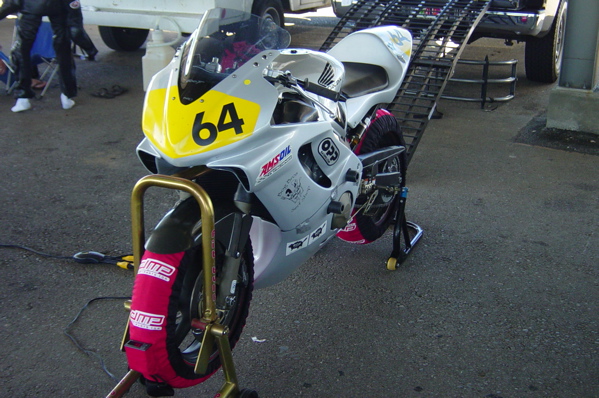
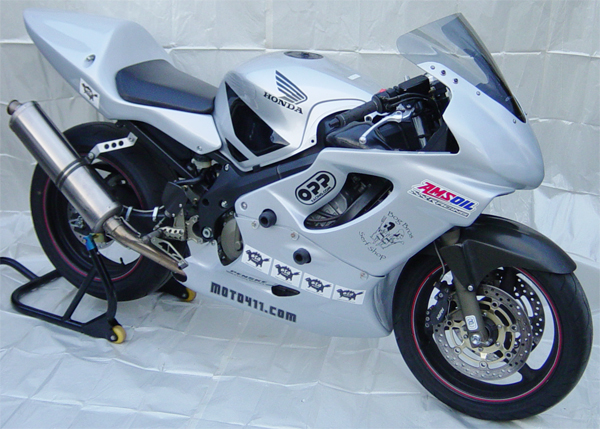
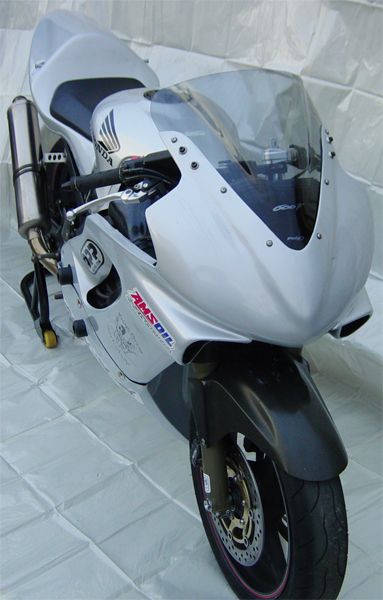
The bike is a 2001 Honda CBR600 F4i. Certainly not the latest technology, but it's in great mechanical shape and many parts are available for the bike.

Moto411 Race Bike:

Moto411 Race Bike:

When We're Racing

We aren't going to race every round this year—perhaps only 4 or 5 races at the tracks closest to us. We will have schedule updates when they become available. As much as we encourage you to come by and say hello (mention you read this on Moto411.com and get some free stickers), don't expect to see us leading any packs or winning any races—not this year anyway. We will have a yellow "rookie" number plate and we plan to use it. This year I will adopt the name Slowie McSlowerson and report on our AFM racing progress and the things we learn and any tips we have for newbies coming after us.

"Sponsors"

We would like to take a minute and thank our "sponsors": Moto411.com, Big Pussy Racing and Bog Bros Serf Shop. Anytime you support one of these brands, you support us and our quest to build this site into an ever more useful source of honest information and reporting.

"Sponsors":

Wednesday, November 15, 2006

Part Review: ProGrip 717 Dual Compound SuperBike Grips

Quality: ++++-(4 out of 5)
Functionality: ++++-(4 out of 5)
Appearance: +++--(3 out of 5)
Value: ++++-(4 out of 5)
Overall: ++++-(4 out of 5)
Pros:
  • what vibration?
  • huge selection
  • ProGrip website lists grip lengths(!)
Cons:
  • ProGrip website is somewhat terse on other details (open-ended vs. close ended)
  • some styles are somewhat poseur-esque (that may be a positive for some of you)

Buy ProGrip grips at Amazon.com.

Introduction

Still wanting more from my previous attempt to find decent aftermarket grips, I decided to give ProGrip a try.

Appearance-wise, ProGrips are probably the antithesis of the Renthals. At the time of this writing, ProGrip has over 50 distinct styles utilizing single-, double- or even triple-rubber compounds in seven different categories (covering everything from jet skis to scooters). Due to the huge selection, and since I was ordering these online, this review is as much about my online shopping experience as it is about the grips themselves.

I started at the ProGrip website, which is a pretty daunting place. I had no idea their product offering was so vast. The website has multiple menus, sub-menus and sub-sub-menus, but, since I knew exactly what I was looking for, it was only moderately difficult to navigate to the motorbike grips section.1

To keep things simple, I limited myself to their "SUPER BK" section. Ultimately, I decided on the 717s partially because the grip pattern was similar to the Renthals (and I liked how those performed in that area) and also that they were among those most likely to fit my 2005 YZF-R6. The fact that they were the least obnoxious didn't hurt (I ordered the subtle black-gray color scheme).

Impression

Right away, I noticed a difference between the quality and substance of the ProGrips compared to the Renthals. They were definitely thicker and somewhat more supple. The black-gray theme was not nearly as offensive as I thought it would be based on the website pictures.

Installation

Since I had already removed my stock grips when I installed the Renthals (and since I didn't use grip glue), installation was a non-event. After I removed the safety wire, the Renthals slipped right off with a little compressed air and the 717s went right on with a little isopropyl. I applied new safety wire, waited a few hours for the isopropyl to evaporate, and I was good to go.2

Use

I have to say that, after my first hour-long ride with the ProGrips, I was very pleased. While the grips did transfer some vibration, it wasn't debilitating. Furthermore, they seemed just as grippy as the Renthals—which was the Renthals' one redeeming factor.

The true test was still to come. An hour-long road ride might be comparable to 20 minutes on the track, much less an entire day there. Seeing if the ProGrips provided continued comfort under more extreme riding conditions was the perfect excuse for a track test!

After giving them a spin at Thunderhill, I can honestly say that they did a job damping vibrations while providing comfortable grip, good throttle control, and just the right amount of front-end feedback. I didn't do a back-to-back comparison with the Renthals and my stock grips (which would have been the best method for comparison), but at this point, I almost don't feel it's necessary since this is the first time I've been clearly content with my grips.

Conclusion

I should acknowledge that evaluating motorcycle grips is highly subjective and rider personalities vary significantly. I've known motorcrossers-turned-roadracers who insist on using off-road grips on their race bikes. That's probably why it makes sense for ProGrip to offer as many styles as it does.

That being said, I think I'm finally happy with my own grip situation. Also, since I ride on the road as well as the track, reducing vibration while maintaining feel is important to me, but a competent racer using them exclusively for the track might have different demands (more feedback, lower cost of replacement, etc.). What I can tell you is that the ProGrips cost was pretty similar to that of the Renthals, but because they performed so much better for me, I feel like I got more bang for my buck. I would definitely recommend giving them a try.

1. I have to take this opportunity to express my dissatisfaction the ProGrip website. It relied too heavily on JavaScript and, personally, I hate it when JavaScript/Flash is a necessary part of navigation. One of the most detrimental side-effects of this approach is that I, as a consumer, can't copy the URL from my browser and e-mail it to bigpuss for a second opinion.

With website design, as a general rule, keep it simple. An elegant solution won't make a consumer think too much. Read Don't Make Me Think: A Common Sense Approach to Web Usability, and remember (as Mr. T would say) KISS: Keep It Simple Sucka.

2. bigpuss actually has perfected an approach using only compressed air to pull grips off and slide them on. Mastery of this approach allows almost immediate gratification since there is no isopropyl that must evaporate. I encourage you to experiment and find your own best method.

Monday, October 16, 2006

Part Review: CBR600 F4i Windscreens - Puig vs. Zero Gravity

Buy Puig windscreens at Amazon.com.

Introduction

It was less than 48 hours until we were supposed to be at the track and I needed a new windscreen. Okay, I wanted a new windscreen. Mine was scratched and old and, although I'm typically not one for vanity, the track day was mostly made up of Ducatis and I was bringing a Honda. I stopped at my local dealership to pick up a windscreen. (Normally I would order one online, but time was short.) They said they could order me a Zero Gravity windscreen and it would arrive the following morning, in time for my track day. Being familiar with Zero Gravity's product, I gave them the green light and headed to another dealership to cover my bases—just in case the "following morning" was actually next week. The alternate dealership had a Puig Racing windscreen in stock. Figuring a windscreen in hand was worth two the morning of the track day, I purchased the Puig as well.

I admit I wasn't familiar with Puig products, but seeing the windscreen in person before buying it put me at ease. The windscreen seemed well made, robust, and I liked the "bubble" form of the Racing series. I'm not a small person by any means and when you're on a 5-year-old 600 constantly going up against liter-bikes on the straightaway, any aerodynamic advantage—whether perceived or real—can help.

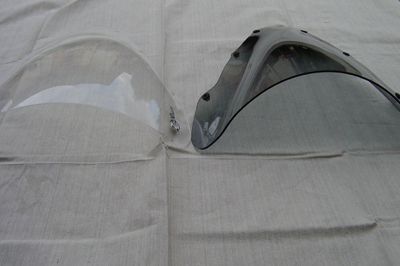
Puig (tinted) vs. Zero Gravity (clear):

Impression

Both were roughly $70 and both were easy to install. Each seem of good quality. However, I immediatly noticed a difference in material thickness betwen the two as can be seen below.

The Puig is clearly thicker:

Additionally, I liked the "bubble" on the Puig Racing windscreen. In all fairness, Zero Gravity does offer three different styles: the SR, Double Bubble, and Sport Touring. The "Double Bubble" is akin to Puig's Racing series and the "SR" is akin to Puig's "Standard" series. Given that the Puig screen is made with thicker material and you get the "bubble" for the same price as Zero Gravity's standard SR model, I was happier with my Puig purchase.


Installation

Installation was simple, straightforward, and the same on both screens.

Use

Figuring the Zero Gravity would be very similar to my stock windscreen, I used the Puig at the track. Overall, it performed very well...how can a windscreen really perform badly unless it cracks or flies off? I really liked the racing bubble profile. I'm sure it was a total placebo, but I couldn't attribute making time on 1000cc Ducatis on the straightaway to anything else as I know it wasn't rider skill.

It's worth noting that I have no long-term results yet. I don't know how each responds to prolonged sun exposure, repeated cleaning, abuse at track days, or a crash. I will update my review when I start getting that kind of data.

Conclusion

If I had to return one of the windscreens, I would return the Zero Gravity. Of course I will continue to use both and log future observations.

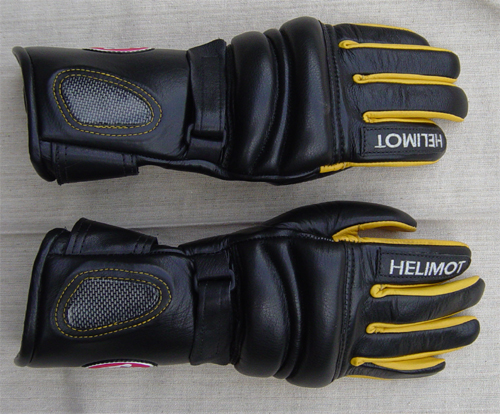
Gear Review: Helimot Gloves

Quality: ++++-(4 out of 5)
Functionality: +++++(5 out of 5)
Appearance: +++--(3 out of 5)
Value: +++--(3 out of 5)
Overall: ++++-(4 out of 5)
Pros:
  • Extremely comfortable
  • Custom tailored fit
  • Quality Workmanship
  • Kangaroo
  • Locally made (for me anyway)
Cons:
  • Not cheap
  • Styling might not be for everyone

Introduction

I knew I needed a new pair of gloves soon, but I really hadn't given any thought to what I was going to get. My multiple pairs were getting too worn, coming unstitched, soaked by sweat at the track only to dry hard in the sun too many times, etc.

I wasn't really putting off buying new gloves, but gloves didn't really excite me. I'm pretty sure this was due to the fact that I've never had a pair I really liked. I've never experienced the comfort of what a motorcycle glove could and should be. Mine typically start to bunch in the palm, cut off circulation to my pinky finger, have one or two fingers that are too long, etc. Even "good" gloves (which I'm pretty sure just means "expensive") haven't been any better. However, as a disclaimer, I've never owned any really good/expensive gloves.

Well, a couple weekends ago, I found myself at a silent auction raising money for a local fire department which helps quite a few motorcyclists in need. Staring me in the face was a nice looking pair of gloves from a brand I had heard was pretty good. I placed my $130 bid and left for the day. I got the call last Monday that I had won the gloves. I was really excited; new gloves on the cheap! The gloves on which I bid were sent to me and all I had to do was go to the local shop and exchange them for something my size. Luckily for me, the Helimot shop is literally walking distance from my house...so off I went.

Impression

Glove at first sight! When I slipped into my new gloves at the shop, it was a life-changing event. Motorcycle gloves can be comfortable! (In fact, I'm typing in them right now.) Nothing poked my hand; nothing felt rough or hard; it was all smooth and soft; and, most importantly, the gloves barely limited my digital dexterity. The only things a bit off were the thumbs and two fingers—I have short fingers and they were too long. I was told to go break them in with a few rides and bring them back to be tailored to my finger length. I was in shock! Now, the alterations do cost $7 a finger, but considering I got a $200+ pair of gloves for $130, the few bucks for alterations seemed like a good deal.

The best gloves I've ever owned:


The palms are soft and flexible kangaroo hide without superfluous material and the seams are in out-of-the-way places. Compare the palm of the Helimot glove above with an old glove of mine below. The glove below has all sorts of who-knows-what going on. All that material and all that stitching kept bunching up to make a horribly uncomfortable and sometimes painful lump. The Helimot gloves don't do that. But what about safety? The entire palms of the Helimot gloves are two layers thick, and yet they still retain the flexibility you need in a motorcycle glove.

Old, bad glove:

Although they may not look it, the Helimot gloves offer superior protection throughout. The padding on top is thick, yet flexible and, despite it not having carbon fiber knuckle protectors, I suspect these would do a better job at protecting one's hands in an accident. The soft padding does give the glove a sort of "Darth Vader" look which some may not like. I happen to really like the styling of the glove. And believe me, you will get over your style concerns if you try them on. To visually highlight what I mean, compare the inside of the old glove with the Helimot.

Old glove:

Hand heaven:

Use

I'm a few rides in and they're still great. I'm going to bring them in for the alterations soon; they should be even better when I get them back.

Conclusion

Good gloves are worth the money, as long as you are actually spending your money on good gloves. The Helimot gloves I got were less expensive than top-of-the-line gloves from more mainstream brands and far more comfortable. Even after the custom alterations, the price will still be comparable. Not all expensive gloves are good, but these are thus far.

Part Review: Gilles Rearsets 2001 CBR600 F4i

Quality: ++++-(4 out of 5)
Functionality: ++++-(4 out of 5)
Appearance: +++++(5 out of 5)
Value: +++--(3 out of 5)
Overall: ++++-(4 out of 5)
Pros:
  • Solves stock F4i rearset "problem"
  • Great feel, good grip, smooth shifting
  • Excellent craftsmanship
  • Are they not hot?
  • Replacement parts sold individually
Cons:
  • Not cheap
  • Not cheap at all

Buy Gilles rearsets at Amazon.com.

Introduction

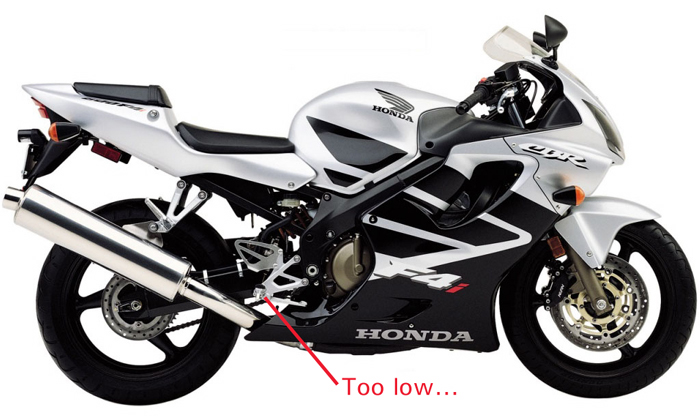
Anyone who owns a Honda CBR600 F4i knows the bike, save the seat, is extremely comfortable given its above average handling capabilities. That comfort comes at a cost though; for any aggressive riding, the foot pegs are far too low.

Seen here, the stock F4i rearsets are too low:

This can lead to a serious medical condition known as Toeis Nomoreis. If Toeis Nomoreis is allowed to progress, the cost in footwear alone can be exorbitant.

A bad case of Toeis Nomoreis:
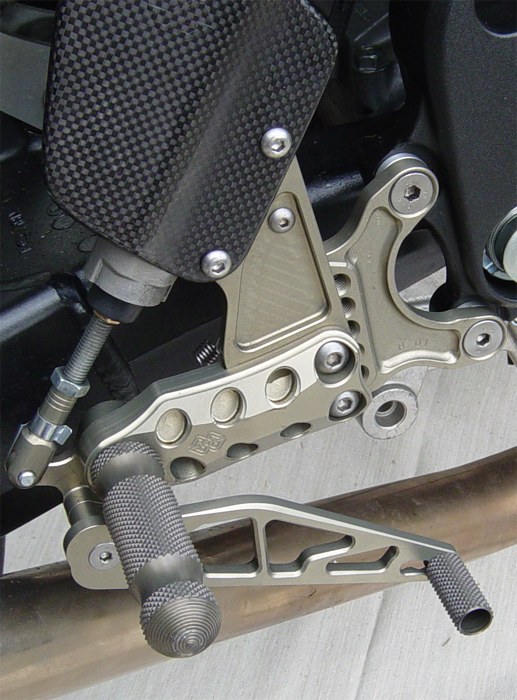
The only thing that could solve my problem was a pair of aftermarket rearsets. I took lugnut's advice, read his review and ordered some Gilles rearsets.

Impression

Wow! lugnut was right. The rearsets continued to impress me from the time I got the box until long after I hit the road. Lucky for lugnut everything he reported was dead on, as I know where he lives. I liked the black ones lugnut chose, but I went with the "titanium" color to match my bike.

Right side:

Left side:

Installation

Installation was simple and straightforward. Unlike with lugnut's R6, the F4i rearsets did not require any creative shift linkages. However, when purchasing the rearsets, I had to explicitly decide between standard or inverted shifting.

Use

Having sat on lugnut's bike when he had his Vortex rearsets, I was worried about grip on an aftermarket foot peg. I was pleasantly surprised with the Gilles pegs. Fantastic grip, smooth shifting and, best of all, my Toeis Nomoreis has been cured.

Conclusion

True, they are expensive, but find me some quality aftermarket rearsets that aren't. Given the price, I could have lived without them if my stock rearsets weren't so low. But, due to the problems with my boots, these were a necessity. For the F4i, I think the Gilles rearsets represent a good solution for riders encountering similar issues.